
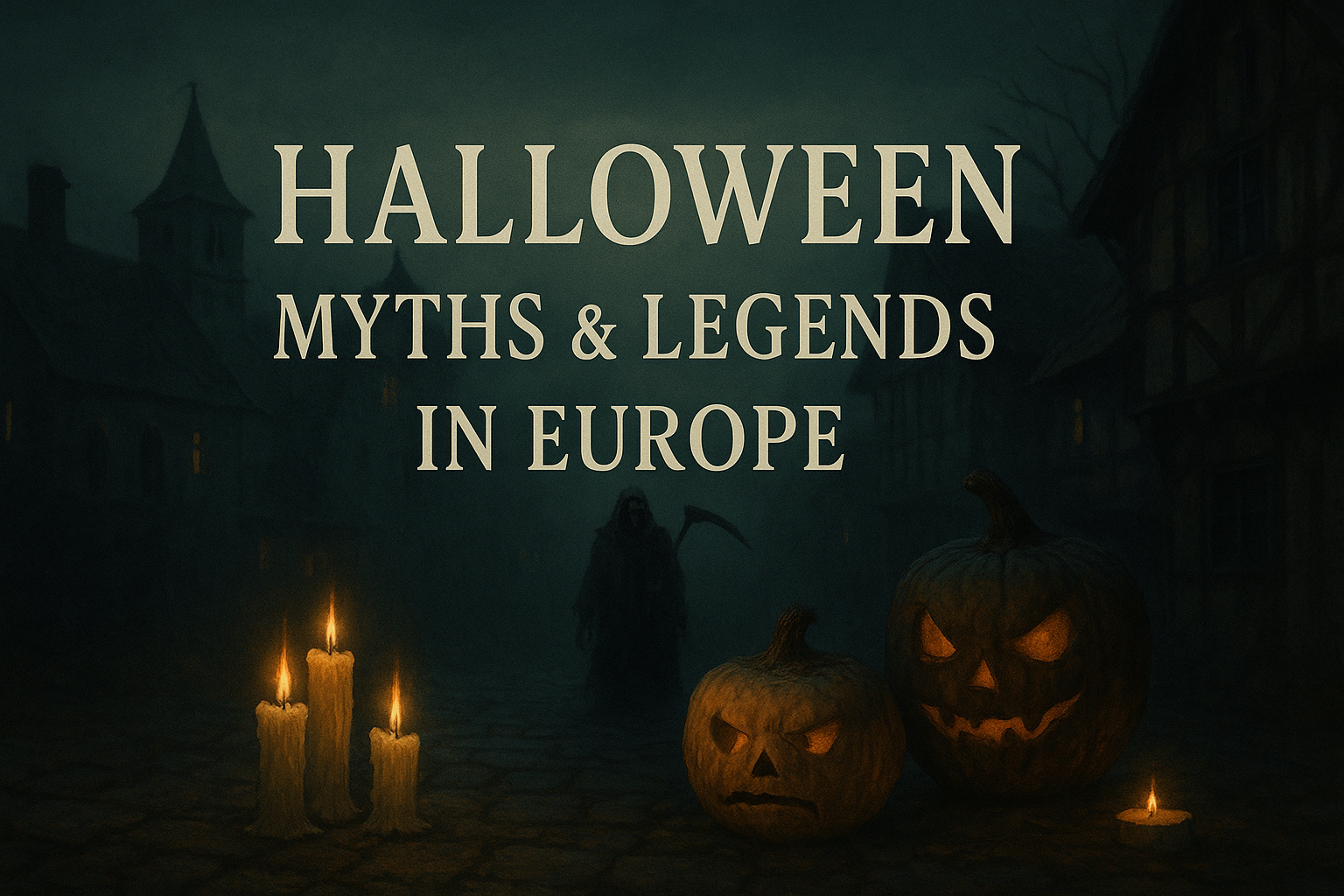

Ireland, Scotland, Wales, Isle of Man, and Cornwall
Ireland (Samhain & Stingy Jack).
If Halloween has a home base, it’s Ireland, a central location for those interested in Halloween in Europe. Samhain (pronounced “SOW-in”) marked summer’s end, the harvest’s close, and the start of the dark half of the year. It was a “thin” time—when boundaries between worlds blurred and the dead, aes sídhe (fairy folk), and other wanderers could slip through.
Bonfires were communal and protective. Fortune-telling involved apples and nuts. Doors were left ajar for visiting ancestors. The jack-o’-lantern comes from an Irish folktale about Stingy Jack. He was a trickster who outwitted the Devil several times. Jack was doomed to wander with only a coal ember inside a carved turnip.
When Irish and Scottish immigrants headed to America, pumpkins—larger and easier to carve—took over. The basic lesson: never out-prank a prince of darkness unless you’re good with eternal night-hikes.
Scotland (Guising & Nut-Crack Night).
Scotland’s Halloween roots are strong and practical. They are like a good jumper against the North Sea wind. Children traditionally “guised” (disguised) and performed a song, a poem, or a trick to get treats. This is a lovely ancestor of modern trick-or-treating. It also requires actual talent. “Nut-crack night” involved hazelnuts in the hearth. People tested romantic compatibility this way. If the nuts crackled together, sparks would fly in life too. If they leapt apart, the fire has spoken. Scotland kept alive turnip-lantern carving longer than most. Photographic evidence suggests these can be scarier than pumpkins.
Wales (Calan Gaeaf & the Hwch Ddu Gwta).
The Welsh Noson Calan Gaeaf is the eve before the first day of winter. It has a classic ysbrydnos (“spirit night”) atmosphere. Watch out for the Hwch Ddu Gwta. It is a tailless black sow that prowls the dark. Sometimes, a headless woman called Y Ladi Wen (“the White Lady”) is seen too. Fires, charms, and prudence were advised. Drifting too close to churchyards was a hard “nope.” Romantic fortunes were also popular. Apples, mirrors, and kale stalks had their moment in the prophecy spotlight.
Isle of Man (Hop-tu-Naa).
The Manx celebration Hop-tu-Naa predates modern Halloween and is delightfully distinctive. Children used to carve grotesque faces into turnips, parade them to a special song (often about “Jinny the Witch”), and go door to door. It’s Samhain with island flair—proof that the Irish Sea has always known how to throw a seasonal party.
Cornwall (Allantide).
Down in Cornwall, Allantide centers on bright red Allan apples, gifted to bring luck as winter looms. Forget plastic skeletons—beautiful apples hung in homes do the protective work just fine. Apple bobbing, apple divination, apple everything… the ethos is basically: one fruit, many destinies.
England & the Old Souls: Souling, Mumming, and Bone-Fires
Mischief Night and Guy Fawkes Day (5 November) get a lot of press in England, but All Hallows’ Eve and All Souls’ Day left deep marks too. Medieval “souling” involved the poor (or children) going door-to-door, singing for soul cakesin exchange for prayers for the dead of the household. Some scholars see this as a bridge between medieval piety and modern trick-or-treating. Early “mumming”—masked, costumed processions with skits—also made appearances around this season. As for bonfires: yes, they were literally “bone-fires” in certain medieval contexts, with bones or symbolic remnants burned as purifications. Imagine a fire that crackles with both heat and theology.
Brittany & the Atlantic Edge: The Ankou and the White Processions
Brittany (France) has a gift for austere, beautiful folklore. Among its most prominent figures is the Ankou, a skeletal reaper who drives a creaking cart to collect souls. In some parishes, he is the last to die in the old year, serving as a sort of local psychopomp for the upcoming year. Coastal mists, chapel bells, and a silhouette on a lane all contribute to Brittany’s sense of dignified dread. Furthermore, along the Atlantic façade—from Galicia to Asturias—you’ll encounter similar processions of the dead. For example, Galicia’s Santa Compaña features a spectral procession of souls bearing candles, led by a living person who remains trapped until they can pass the burden on. Additionally, if you smell wax at midnight when no one’s around, it might be a sign to head home quickly.
Iberian Autumns: Samaín, Gau Beltza, and Castanyada
Galicia (Spain) has enthusiastically revived Samaín, explicitly acknowledging the Celtic roots shared with Ireland and Brittany. Expect pumpkins, costumes, and nods to ancestral visitation. Nearby Asturias and Cantabria tell of the Güestia—ghostly night processions that warn the living into piety and good behavior (there’s nothing like a spectral marching band to make you file your taxes).
In the Basque Country, Gau Beltza (“Black Night”) has surged back: turnip lanterns, costumes, and folk music retell older tales of witches (sorginak) and nighttime spirits. Meanwhile in Catalonia you’ll taste the Castanyada—roasted chestnuts, sweet potatoes, and panellets (marzipan cookies). It’s more reflective than jump-scarey, yet perfectly in tune with honoring the dead around All Saints. In Portugal, children go door to door for Pão-por-Deus (“bread for God”) on November 1—a tender echo of souling that centers hospitality and remembrance.
Italy & the Friendly Dead: Gifts from the Ancestors
Italy’s Nov 1–2 period can be wholesomely eerie. In Sicily, the Festa dei Morti (Feast of the Dead) brings the charming belief that deceased relatives leave gifts and sweets for children. For example, these include marzipan fruits and ossa dei morti (“bones of the dead”) cookies. The message is clear: your ancestors are close, loving, and not opposed to a little sugar economy. Similarly, Sardinia observes Is Animeddas or Su Mortu Mortu, where children once recited prayers or verses for offerings—again, reflecting that souling rhythm. Moreover, across the peninsula, Ognissanti (All Saints) and Tutti i Morti (All Souls) are times for cemetery visits, candlelight, and pastry cases that look like a Gothic bakery’s dream.
The Germanic & Alpine Zone: Lanterns, Wild Hunts, and Things That Go “Huff” in the Night
Germany’s modern Halloween is a lively import, but the region is hardly myth-poor. In parts of southern Germany and Switzerland, turnip-lantern processions (Räbeliechtli or Rübengeister) historically clustered around St. Martin’s Day in November—cousins to jack-o’-lanterns with their own rhythms. Folklore here also teems with the Wild Hunt—a spectral cavalcade racing across winter skies, often led by Wodan/Odin, Dame Holle, or another numinous figure. While most Wild Hunt lore peaks midwinter, its themes—ragged borders between worlds, perilous crossings—hum with the same electricity we feel at Halloween.
In Austria and the Alps, much of the big mask-and-monster energy (Perchten, Krampus) erupts in December and January, but All Saints’/All Souls’ customs—candles on graves, bread for departed souls (Seelenbrot)—hold the season’s reflective core. The idea is constant: light the dark, feed the dead, and keep the social contract tidy on both sides of the veil.
The Nordics: Quiet Flames and Restless Beings
In Sweden, Alla helgons dag (All Saints’ Day) lights cemeteries with an ocean of candles; it’s calm, communal, and moving. The folkloric underbrush includes mylingar—restless child spirits—and gårdsgårdsrå (farmstead spirits), reminders that the unseen share fence lines with the living. Norway and Denmark keep similar churchyard traditions. Finland’s Pyhäinpäivä harmonizes candlelit remembrance with long northern nights.
For mythic bells and whistles, the Norse draugr—undead revenants, stubborn as granite—are evergreen. They’re more saga-season than Halloween-night per se, but the lesson translates: respect barrows, and do not wake what is better left asleep. (This is also excellent museum etiquette.)
Central & Eastern Europe: Dziady, Dušičky, and the Vampire Problem
Head east and you’ll meet ancestor rites that are equal parts philosophy and goosebumps. In Poland, Zaduszki (All Souls) brings crowds to cemeteries, glowing with candles against chilly air. Further back you find Dziady, ancient Slavic rites (also known in Belarus and Lithuania) where living communities welcomed and fed ancestral spirits, sometimes at crossroads or specific hearths. The tone is reverent, a reminder that the living are merely the most recent tenants of any village.
The Czech Republic and Slovakia observe Dušičky, another candlelit communion with the dead. It’s soft-spoken, intimate, and a photographer’s dream—if you go, behave like a guest, not a content goblin.
Of course, Romania brings us the (in)famous strigoi—restless, sometimes vampiric spirits that can leave graves and cause trouble. Rural traditions around Sântandrei (St. Andrew’s Night, late November) involve garlic, wolves, and apotropaic rituals. It’s not “Halloween,” but it shares the core fear and fascination: when does the night belong to us, and when do we belong to it? The broader Balkans have vampires long before Hollywood did; the very word “vampir” is South Slavic. Folk solutions included iron nails, poppy seeds (vampires allegedly count things—useful), and a robust community consensus on who is or is not undead. (Try settling an HOA dispute with that rulebook.)
Greece rounds out the region with the vrykolakas, a revenant sometimes blamed on improper burial or a life of impiety. The islands add their own local curlicues: apotropaic symbols, charms, and priests with steady nerves.
The Baltic States: Vėlinės and Returning Guests
In Lithuania, Vėlinės (All Souls) is a luminous cemetery evening, aligned with honoring ancestors and, in older layers, welcoming them back into the home with food and warmth. Visitors might leave extra places at the table or small offerings on graves. The Baltic message is gentle and firm: the dead are kin; behave accordingly.
What Ties It All Together?
Across Europe, three bright threads weave Halloween and its kin:
- The Year Turns Dark. Agrarian life taught that late October/early November is a pivot: harvest done, fields bare, nights long. Communities respond with light—bonfires, candles, lanterns—to assert human order amid creeping cold.
- The Veil Thins. Whether you call it Samhain, Dziady, Vėlinės, or All Souls, this season suggests the living and the dead are neighbors with a shared fence. Customs offer hospitality to ancestors and defense against less welcome visitors. Food for grandma’s spirit; garlic for the thing that is emphatically not grandma.
- Masks and Meaning. Costumes, mumming, and guising invert daily roles. A peasant becomes a specter; a child becomes a queen; a village rehearses chaos to keep real chaos at bay. Humor isn’t a side dish—it’s apotropaic: we laugh at the dark to keep it from swallowing us.
Practical Notes for Modern Travelers (and Story-Lovers)
- Expect candles and calm. In many countries, October 31 is fun, but Nov 1–2 carry the heart of remembrance. If you visit cemeteries, be respectful—quiet voices, no flash, and offer a candle rather than a selfie.
- Try the seasonal sweets. From Sicilian marzipan fruits to Catalan panellets and Polish pastries, autumn is edible folklore.
- Look for lanterns. Turnip, pumpkin, or paper—the light in the dark is the hallmark of the season from Galway to Gdańsk.
- Ask locals about “the old way.” Revival festivals (Samaín in Galicia, Gau Beltza in the Basque Country) blend community pride with ancient motifs. You’ll often find music, craft, and storytelling that hit deeper than jump scares.
One Last Candle
Halloween in Europe isn’t just about frights; it’s about belonging—to the land, to the past, to each other. The continent’s legends insist the world is full of company: ancestors who want a seat at the table, tricksters who test your wits, guardians who patrol the crossroads, and yes, the occasionally nosy reaper in a creaking cart. Light a lantern, leave a small gift for whoever walks with you, and step into the dark half of the year with good manners and better stories. If something bumps in the night, assume it’s a neighbor… until it counts your poppy seeds.
Leave a Reply